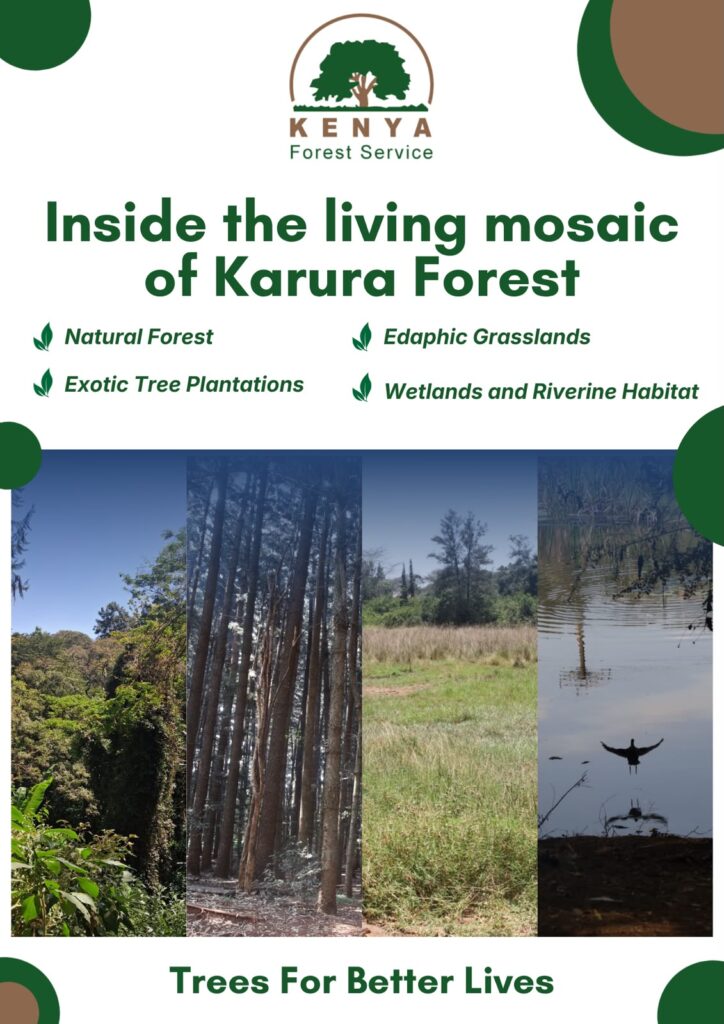
Karura Forest sits within Nairobi, a few minutes from the city’s traffic and noise. To a visitor, it looks like one continuous canopy. Its ecology is more varied than that. Karura is a mosaic of four distinct habitats, each with its own plants, wildlife and role in keeping the forest and the city around it, healthy.
Natural Forest: The indigenous core
The natural forest is dominated by indigenous trees that have evolved with this landscape over generations. It is the backbone of Karura’s biodiversity. Its layered canopy, deep leaf litter and mature trees provide food, shelter and nesting space for a wide range of wildlife, from birds and primates to the insects and fungi that keep the forest floor alive. Indigenous forest also stores carbon, cools the surrounding air and builds healthy soils. It is the habitat the other three are measured against.
Exotic Tree Plantations: A forest in transition
Parts of Karura were originally planted with exotic tree species for commercial purposes, as was common in forestry management across the country. Today the story of these plantations is one of renewal. They are being gradually replaced with indigenous trees so that the natural ecosystem can return. The work is deliberate and unhurried. Forest restoration is measured in decades and each indigenous seedling established in a former plantation block is an investment in a richer, more resilient forest for future generations.
Edaphic Grasslands: Open spaces with a purpose
Not every open space in a forest is a gap to be filled. Edaphic grasslands are open areas where soil conditions, rather than climate alone, determine what grows. They are home to native grasses that support grazing herbivores and serve as breeding grounds for certain bird species. These clearings add diversity to the landscape and shelter species that would not thrive under a closed canopy. They are a natural part of the forest’s design and are protected as such.
Wetlands and Riverine Habitat: The forest’s water system
Karura’s wetlands and riverine areas include stands of papyrus reeds and the riverine catchment along its watercourses. This habitat protects water sources by filtering and slowing the water that moves through the forest and it provides a home for aquatic species. A healthy catchment keeps Karura’s rivers flowing cleanly and it is a service the whole city benefits from, whether or not it is noticed.
Each of these habitats supports species the others cannot. Together they make Karura an ecosystem that is resilient, productive and valuable well beyond its boundaries. Protecting the forest means protecting all four and that requires everyone who visits, works in or lives near it to take part.
Karura is more than a green space in the city. It is a working ecosystem that the Kenya Forest Service manages, restores and protects.